Leak detection equipment, used in a particular order.
Every van carries all of them, because no single method is reliable on its own. A thermal camera reads heat, which is why a warm floor can mislead it. An acoustic sensor hears pressure. Applied in the right sequence they narrow a property down to a single point.
Seven days a week, 7am to 9pm
- 4.7from 1,629 reviews of ADI Leak Detection
- No find, no feeon qualifying jobs
- £5mpublic liability
- AccreditedCIPHE, WIAPS, WaterSafe, SPATA
The sequence matters more than the kit.
- 1
Non-invasive first
Meter readings, moisture mapping, thermal imaging and acoustic listening. Nothing is touched or opened. On a good proportion of jobs this is as far as it needs to go.
- 2
Isolate and test
Hot, cold, heating and underfloor circuits are separated at the manifold or stopcock and pressure tested individually. This narrows the fault from the property to a single circuit.
- 3
Introduce tracer gas
The failing circuit is drained and filled with a hydrogen and nitrogen mix, which escapes at the break and rises through concrete and tile to a detector at the surface.
- 4
Open up, once
Once two or three methods agree on the same point, the opening is made there and nowhere else. A borescope usually goes in first so the engineer can see before cutting further.
What each one is for.
Thermal imaging cameras
Infrared cameras read the temperature pattern a leak leaves in plaster, tile, screed and concrete. Large areas can be covered quickly, which is why they are normally the first method used.
Acoustic ground and pipe microphones
Highly sensitive ground and pipe microphones amplify the noise of water escaping under pressure. The engineer follows the pipe run and identifies the point where the signal is strongest.
Tracer gas
A safe hydrogen and nitrogen mix is introduced into drained pipework or a void. It escapes at the break, rises through concrete and tile, and is detected at the surface.
Leak noise correlators
Two sensors are clamped to a pressurised main. Each records the leak noise travelling along the pipe wall, and the unit calculates the distance from signal delay, sensor spacing and sound velocity.
Borescope cameras
A flexible tube carrying a light and an HD camera, inserted through an opening about the size of a coin. Wall cavities, floor voids and boxed-in pipework can be inspected directly.
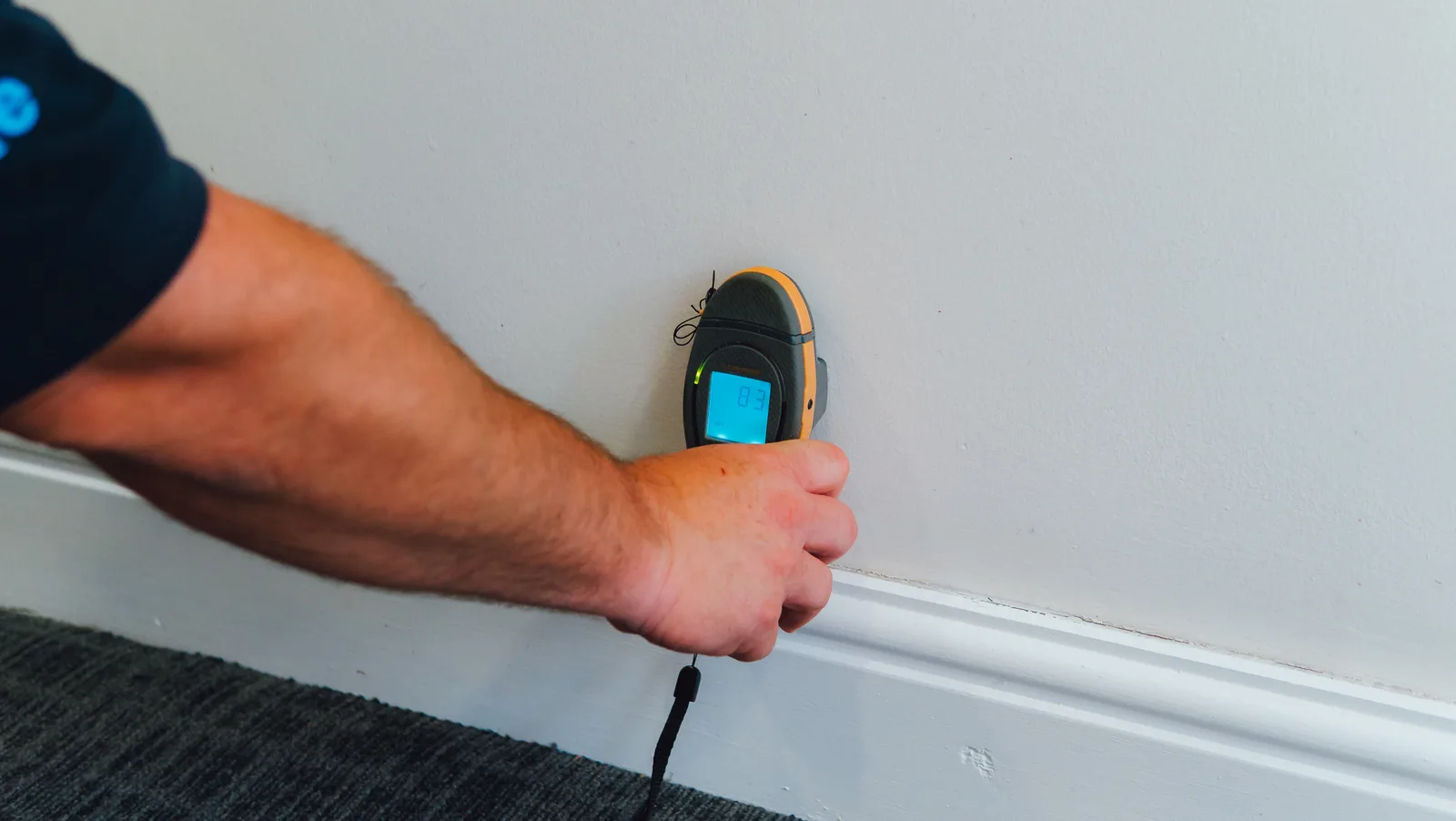
Moisture and damp meters
Pin and pinless meters measure the water held in a wall, floor or ceiling. Readings plotted across a room form a moisture map showing where the water originated.
Pressure testing
Each circuit is isolated and pressurised before any search begins. It establishes which system is losing water, and afterwards confirms the repair has held.
CCTV drain cameras
Push cameras survey drains, gullies and interceptors internally, recording each defect with its distance along the run and its depth.
Drone roof survey
Large, steep or fragile roof areas are surveyed from the air, without scaffold or a tower.
Two methods agreeing is the standard.
Speak to the team that books the engineers.
One call confirms the earliest available date and the price, before you commit to anything.
- You describe what you have seen
- We find the nearest available engineer
- You get a date and a price before booking
Seven days a week, 7am to 9pm. Most home insurance covers the cost of finding a hidden leak.